
Most agents have already invested in their online presence. They have a website, solid branding, often a team behind their marketing. But local search has its own set of rules, and even well-built real estate sites tend to have a few quiet gaps that hold them back from the visibility they should have. These are the local SEO problems we see real estate agents struggling with most often and how to address them.
Mistake #1: An incomplete or neglected Google Business Profile
Google Business Profile is the free listing that controls how you appear in Google Search and Google Maps. When someone searches “real estate agent in [your city],” it powers the local three-pack, the map with featured real estate agent business listings at the top of the search results:
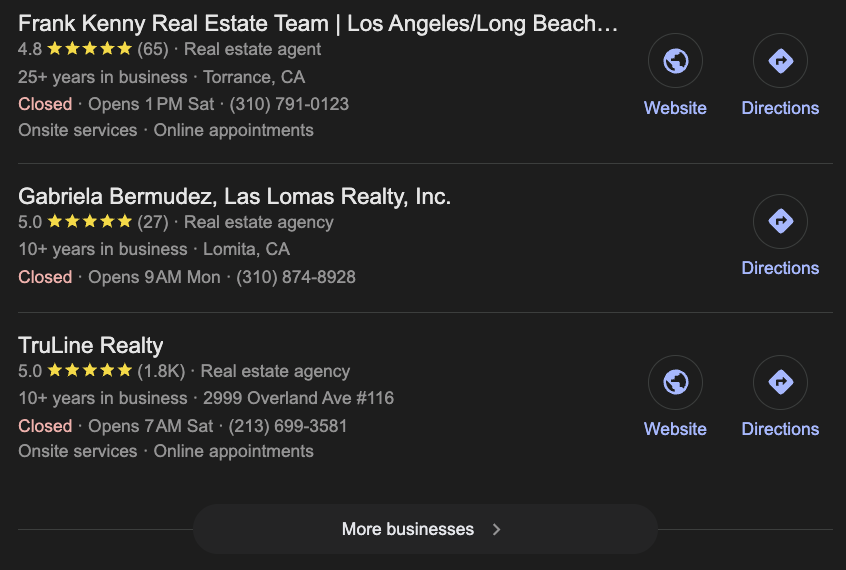
The local three-pack is one of the most valuable pieces of real estate in all of search, and your profile is what determines whether you show up there. Despite this, some agents leave critical GBP fields blank or outdated.
Solution 1: Complete every GBP field and choose the right categories
Start with the basics and make sure every field is accurate and consistent with what appears everywhere else online:
- Business name, address, phone number, website, and hours – These need to match exactly what is on your website and across all other directories.
- Primary category – Choose the most specific option available. “Real Estate Agent” is almost always a better fit than the broader “Real Estate Agency.”
- Secondary categories – Add these for additional services like property management or consulting, but only select categories that genuinely apply. Irrelevant categories can hurt your rankings.
- Business description – Naturally include the terms people search for, like “real estate agent in [city]” or “buying and selling homes in [neighborhood].” Speak directly to your target audience, such as luxury buyers. The first 250 characters show before someone clicks “Read more,” so lead with what matters most.
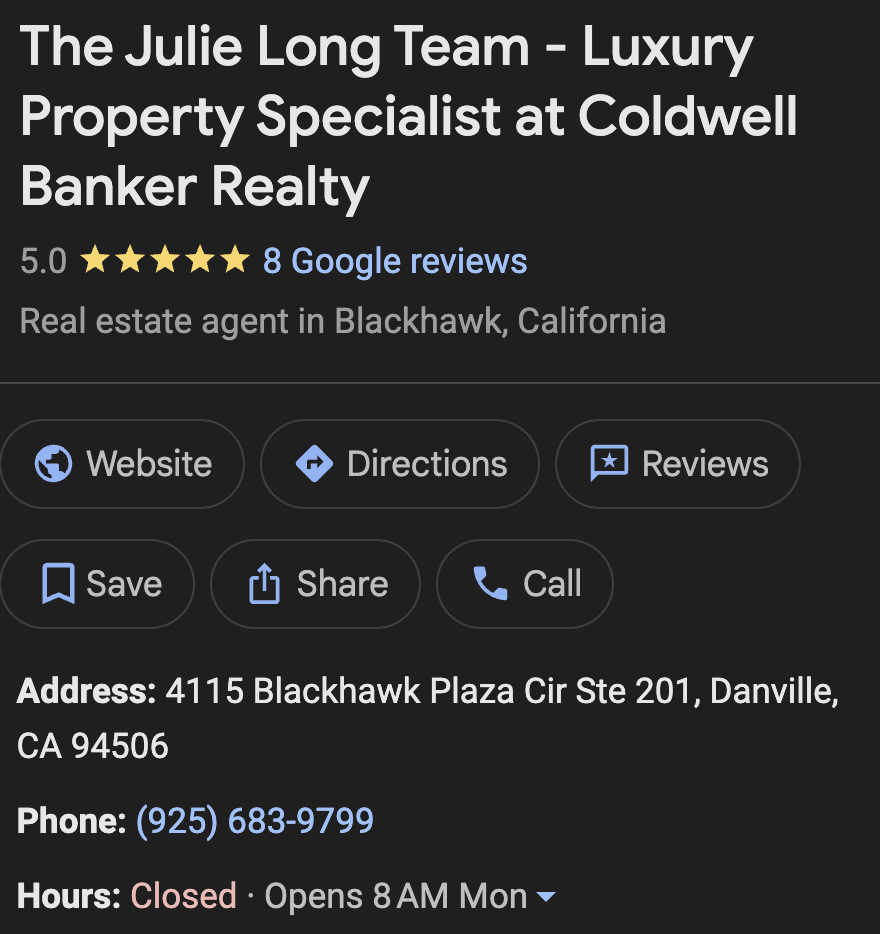
Your Google Business Profile should look something like this when you’re done, with each field filled-out with up-to-date information:
Solution 2: Acquire reviews from past clients
The biggest lever beyond completing your profile is reviews. The more positive, recent reviews you accumulate, the better your chances of showing up in the local pack. Here are some of the most effective approaches real estate agents recommend:
- Ask in person at a high point. When a client says something like “we love the house, thank you so much,” ask if they would share that in a Google review. Send the link while the moment is fresh.
- Get a verbal yes first, then follow up. On a call or at closing, get them to agree, then text the direct link right after. The text feels expected rather than out of the blue.
- Pick one platform. When you ask for Google and Zillow at the same time, people tend to do neither. Lead with Google.
- Frame it as helping the next buyer. Instead of “can you do me a favor,” say something like “your review helps other buyers feel more confident choosing an agent.” People respond better when it feels like they are helping someone else.
Mistake #2: Not building your site’s topical authority on your local market
Many real estate agent websites are missing critical pages, or they have the pages but those pages sit in isolation without supporting each other. Your site should not be a collection of disconnected pages. It should function as an ecosystem where different content serves different purposes for potential clients at different stages, and where every page strengthens those related to it through topical authority. This means covering all the angles of a specific topic in different related pages and internally linking them.
Solution 1: Cluster your related local content
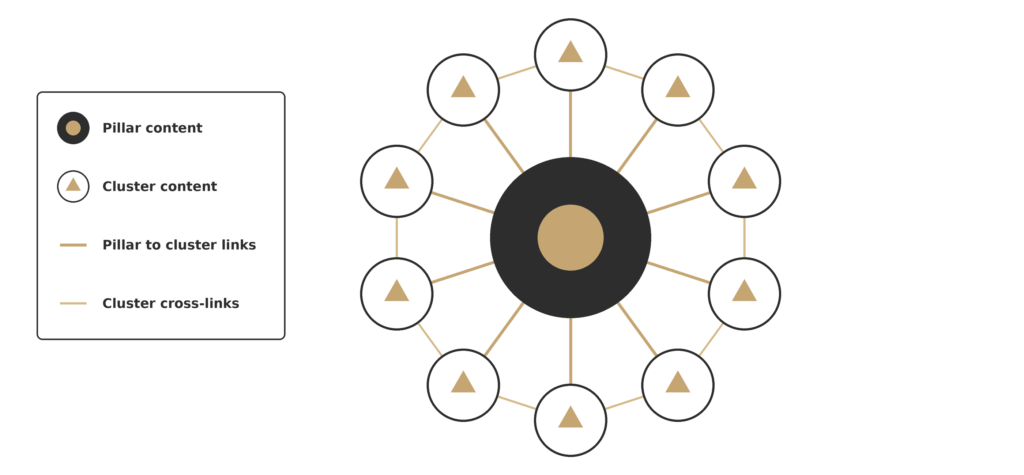
A topic cluster is a group of interlinked pages centered around one broad subject, using a hub-and-spoke model. These are important for local SEO in real estate because Google evaluates your authority on a topic not by looking at a single page, but by seeing how thoroughly your site covers the subject across multiple connected pages. Here is how it works:
- Pillar page (the hub) – A comprehensive main page that covers a broad topic. For a real estate site, this would be your main neighborhood guide or market area page.
- Cluster pages (the spokes) – Detailed supporting pages that each cover a specific angle of that same topic: market trends, school ratings, buying guides, listing pages, lifestyle content.
- Internal links (the connections) – The pillar page links to every cluster page, and every cluster page links back to the pillar. Related cluster pages also link to each other.
This is how you build topical authority in local real estate SEO: Google sees a cluster of interconnected content covering the parent topic comprehensively and treats your site as a credible source for the entire topic, not just one keyword.
Solution 2: Connect your cluster pages with internal links
Having the right pages is only half the job. The other half is linking them together so Google can see how they relate. Internal links pass authority from your stronger pages to weaker ones, and the anchor text of those links tells Google what each linked page is about. Without those connections, even good content sits in isolation and underperforms.
The general strategy is to link downward, across, and back up:
- Downward from your homepage. Your homepage typically carries the most authority from external backlinks. Link from your main navigation to your most important local pillar pages, like your top neighborhood guides, to pass link equity to them and help them rank better.
- Between related content. Blog posts should link to related blogs posts, for example.
- Back up from deeper pages. Listing pages and blog posts should link back to the broader neighborhood or market content that gives them context. This creates a loop rather than a dead end.
When Google sees this kind of interconnected structure around a local topic, it recognizes your site as having genuine depth on that subject rather than a collection of unrelated pages.
You can automate your internal linking using a tool like Link Whisper.
Solution 3: Use descriptive anchor text in your internal links
The anchor text you use matters. Google uses it to understand what the linked page is about, and to get a general idea of what your site offers. “Click here” tells Google nothing about the page you’re linking to. “Silver Lake neighborhood guide” tells Google exactly what the linked page is about.
One thing worth noting: a recent study found that sites with more anchor text variations per URL, meaning many different phrases all linking to the same page, correlated with losing traffic after recent Google updates. The raw number of links did not matter, just the variation. This suggests that using natural, consistent anchor text for a given page may be more effective than trying to vary it creatively each time you link.
If you link to your Silver Lake neighborhood guide from ten different pages, using similar descriptive text each time appears to be safer than rotating through numerous different phrases.
Mistake #3: Publishing local content that could have been written by anyone

Much of the real estate blog content online is written by generalist content writers or generated fully by AI, which is risky. Generic posts like “5 Tips for Buying a Home” without firsthand, practitioner-level clarity or original data insights give Google no signal that the content is helpful to buyers and sellers.
Google’s helpful content guidelines recommend offering demonstrable first-hand experience and original insights, and local search is where this matters because Google is specifically trying to surface local authorities.
Solution: Write expert local content with your own unique insights
Using AI to generate article outlines and content saves time, but make sure you are heavily injecting your own local experience for the AI to use in its outline and content generation. I also recommend editing the outputs so they make sense for humans. Use a tool like Wispr Flow to speak your local insights into a rough draft, then let AI structure and write the content. The substance should come from your experience, not from AI generating advice based on what is already published.
The meaningful difference is where the substance originates. Speaking your market knowledge into a draft and using AI to clean up the structure is fine. Asking AI to generate the insights itself produces the kind of content Google is specifically trying to filter out.
If you have proprietary data such as transaction history, common questions or statements from buyer call transcripts, or internal market data, analyze them using an AI tool like Claude to find new insights and work them into your pages.
Mistake #4: Buying backlinks instead of earning them
A backlink is when another brand links to your real estate website. When a local news site writes an article and includes a link to your neighborhood guide, that is a backlink. Google treats these links as a signal of trust and authority: if other credible sites are pointing people to your content, Google takes that as evidence that your site is worth ranking.
But the way some SEO advice frames backlinks leads agents down the wrong path. It is not the quantity but the quality of backlinks that helps. Buying links on random, low-quality sites is risky. Google can detect purchased links and will either ignore them or, if you really abuse it, penalize you. For local SEO specifically, what matters are links from local sources: local publications, community organizations, neighborhood blogs, event sponsors.
Solution: Reach out to reputable local websites with a reason to link to you
Outreach to reputable local websites with an audience that would appreciate your expertise is the best way to earn links. Pitch ideas for unique content pieces or interviews. The distinction that matters is editorial judgment. A local news editor linking to your neighborhood guide because it’s genuinely useful is a meaningful signal. Paying a service to place your link on an unrelated site with no real audience is what Google penalizes. Outreach to local publications works because the sites doing the linking have real readers and real standards, and they are sharing your content because they believe it’s valuable.
Mistake #5: Low brand popularity
Brand popularity is one of the clearest patterns we see separating agents who rank from those who do not.
The agents who consistently appear at the top of competitive local results tend to have real name recognition. They are on podcasts, active on social media, mentioned in local press. People search their names. That branded search volume tends to correlate with stronger rankings, because recognizable brands attract more links, mentions, and engagement.
We have seen an agent ranking at the top of search results for a competitive keyword with a short, simple article. The content was not necessarily more comprehensive than other articles, but the agent had a TV show, books, and regular podcast appearances. Brand authority was carrying the page past competitors with objectively better on-page optimization.
Solution: Use PR and publicity to build your brand awareness
The TV show example is an extreme case, but the underlying dynamic applies at any scale. Podcast appearances, local press mentions, and community involvement generate the branded searches and natural mentions that compound over time. The same activities that build your local reputation produce the signals that strengthen your rankings.
This extends to AI search as well. A recent study of 75,000 brands found that branded web mentions showed the strongest correlation with AI Overview visibility.
If you’re curious about your own brand popularity, search variations of your brand name on Google Trends.
Mistake #6: Missing structured data
When someone searches for you or your services, Google does not just look at the text on your pages. It also looks for structured data, which is code behind the scenes that tells search engines exactly what your business is, where it is located, and what you offer in a format machines can read directly.
Schema types worth implementing for local real estate SEO include:
- LocalBusiness / RealEstateAgent – The foundation. Defines who you are, where you are located, your contact info, and your service area.
- FAQPage – Makes your answers appear as expandable dropdowns directly in search results.
- RealEstateListing – Marks up individual property listings with price, address, availability, and property type.
- SingleFamilyResidence / Apartment – Tells Google bedrooms, bathrooms, square footage, lot size, and other specifics.
- BlogPosting – Tells Google who wrote each article, when it was published, and what it covers. Use the author property within BlogPosting to reference a Person entity that includes your name, job title, and a link to a detailed author bio page so users and search engines know an expert wrote the content.
Solution: Add structured data to your local web pages
If your site runs on WordPress, plugins like Yoast or Rank Math handle the most common schema types automatically. For more control, the free Schema Builder from schema.dev lets you create markup with a point-and-click interface. If you have a developer, you can add JSON-LD (Google’s preferred structured data format) directly to your HTML. The key rule is that everything in your structured data must match what is visible on the page.
Use Google’s Rich Results Test to check whether your page is eligible for rich results, and optionally a Schema.org validator to catch general syntax issues for all schema types. Monitor the Enhancements reports in Google Search Console to catch issues across your site over time.
Mistake #7: Technical issues that silently block local visibility
All the content and reviews in the world will not help if search engines cannot properly crawl and index your site. Technical SEO problems are invisible to most agents but can quietly destroy local rankings. Everything looks fine to a visitor, but behind the scenes, Google may be ignoring pages, following dead ends, or misunderstanding your site structure entirely.
One issue we have seen severely impact a site’s local SEO overnight: canonical tag misconfiguration. Every page’s canonical tag was accidentally pointed to a single URL instead of self-referencing. Google effectively de-indexed the entire site. Once the canonical tags were fixed, the site was re-indexed, but its rankings did not fully recover for months. Canonical tags usually just work, but a theme update or plugin change can silently break them across your whole site.
Other common technical issues and what they mean:
- Accidental noindex tags on important pages – A noindex tag tells Google not to include a page in search results. Sometimes these get applied during development and never removed. Your most important pages could be invisible to Google without you knowing.
- Missing or broken XML sitemap – Your sitemap tells Google every page that should be indexed. If it is missing or returning errors, some pages may never get found.
- No HTTPS – Google treats HTTP sites as insecure and has confirmed HTTPS as a ranking signal. Most hosting providers offer free SSL certificates.
- Broken internal links and missing redirects – When you remove a page without setting up a redirect, every link pointing to that old URL hits a dead end. The authority that page had built up disappears.
- Slow page speed – Uncompressed photos are only one piece of the problem. Excessive plugins, unminified CSS and JavaScript, no browser caching, poor hosting, and third-party scripts can all slow your site down. Run your pages through Google’s PageSpeed Insights for specific recommendations.
- Mobile usability issues – Google uses mobile-first indexing, meaning it evaluates the mobile version of your site for rankings. Broken layouts, tiny tap targets, and forms that do not work on phones can all drag down your visibility. Test on actual phones.
Solution: Run a technical SEO audit on your real estate website
Run a technical audit periodically using tools like Semrush’s site audit, Ahrefs Site Audit, or Screaming Frog. These tools crawl your site the way Google does and flag problems like broken links, missing redirects, duplicate content, and misconfigured tags. Even the free version of Screaming Frog covers up to 500 URLs, which is enough for most agent sites.
For a free starting point, Google Search Console shows you exactly which pages Google has indexed, which ones it has excluded, and why. Check the Pages report under Indexing regularly to catch issues like accidental noindex tags or crawl errors before they compound.
Prioritize anything blocking crawling or indexing first: broken canonicals, noindex tags on important pages, missing sitemaps. Then work through broken links, missing redirects, and page speed issues.
Key takeaway
Local SEO isn’t one thing you fix and forget. It’s a set of pieces that work better together: a complete Google Business Profile, consistent contact info everywhere you’re listed, content organized around the neighborhoods and topics you know best, original insights only you can provide, links earned from real local relationships, a recognizable brand in your area, structured data that helps Google read your pages, and a site that actually works under the hood. No single fix will transform your visibility overnight, but together they can provide lasting local SEO visibility.
FAQs
What is the most common local SEO mistake for real estate websites?
An incomplete Google Business Profile and business information inconsistency across your website, GBP and directory listings. Both are fixable relatively quickly and have a direct impact on local visibility.
How long does it take to see results from fixing local SEO mistakes?
Technical fixes like crawl issues, on-page corrections, and GBP cleanup can start to show movement within a few weeks, especially in less competitive markets. Content changes and new pages usually need three to six months for meaningful local impact. You generally have to wait until a large Google algorithm update, which happens every 3 to 4 months. Local SEO often surfaces initial results faster than broad national SEO, but in saturated local markets, timelines can stretch longer. Brand-building is the longest play but can make the biggest impact.
Can I do local SEO myself as a solo agent?
You can handle the basics: Google Business Profile, content from your own expertise, NAP consistency, and brand-building. Higher impact strategies like competitive keyword research, matching searcher intent with your content, technical SEO, structured data implementation, content at scale, and tracking are where professional help pays off.

How Luxury Presence can help
Local SEO is straightforward in principle but demanding in practice. The technical work alone, structured data, site architecture, crawl audits, indexing issues, requires ongoing attention and specialized knowledge. Layer on competitive keyword research, content strategy at scale, and keeping up with how Google and AI search are evolving, and it becomes a significant time commitment on top of running your business.
Most agents we work with started by doing the foundations themselves and reached a point where the complexity outpaced the hours they had available. Luxury Presence helps real estate agents and brokerages build the site infrastructure, content strategy, and technical foundation that local SEO demands. If you are ready to move beyond the basics of local SEO, get started here by booking a demo.

![Where Will You Go After You Sell Your House? [INFOGRAPHIC] | Keeping Current Matters](https://files.keepingcurrentmatters.com/wp-content/uploads/2023/03/02131741/20230303_Where-Will-You-Go-After-You-Sell-Your-House-NM.jpg)